Performance Review Calibration Presentation Template

Stop wasting hours on manual formatting. Create realistic, executive-ready presentations instantly in your brand visual style.

Talent density visualizations
Calibration process roadmaps
Merit & promotion frameworks

1What a Performance Calibration Deck Needs to Prove

A performance review calibration deck is not a generic HR meeting pack. It is a governance document that proves leadership has applied consistent standards before making rating, promotion, compensation, and succession decisions. The deck should answer four questions quickly: whether the rating distribution is credible, whether promotion nominations are supported by evidence, whether pay outcomes reflect performance and market reality, and whether the process has controlled for bias or manager inconsistency. A strong calibration presentation leads with the decision required rather than background context. For example, the opening page should state which functions require rating normalization, which promotion cases need executive discussion, and which compensation exceptions require approval. That framing helps senior leaders move from anecdotal debate to structured decision making. The template also gives HR teams a way to document process discipline, which matters when employees later ask how decisions were made. It should leave an audit trail of assumptions, rules, and exceptions so final outcomes can be defended consistently across business units.
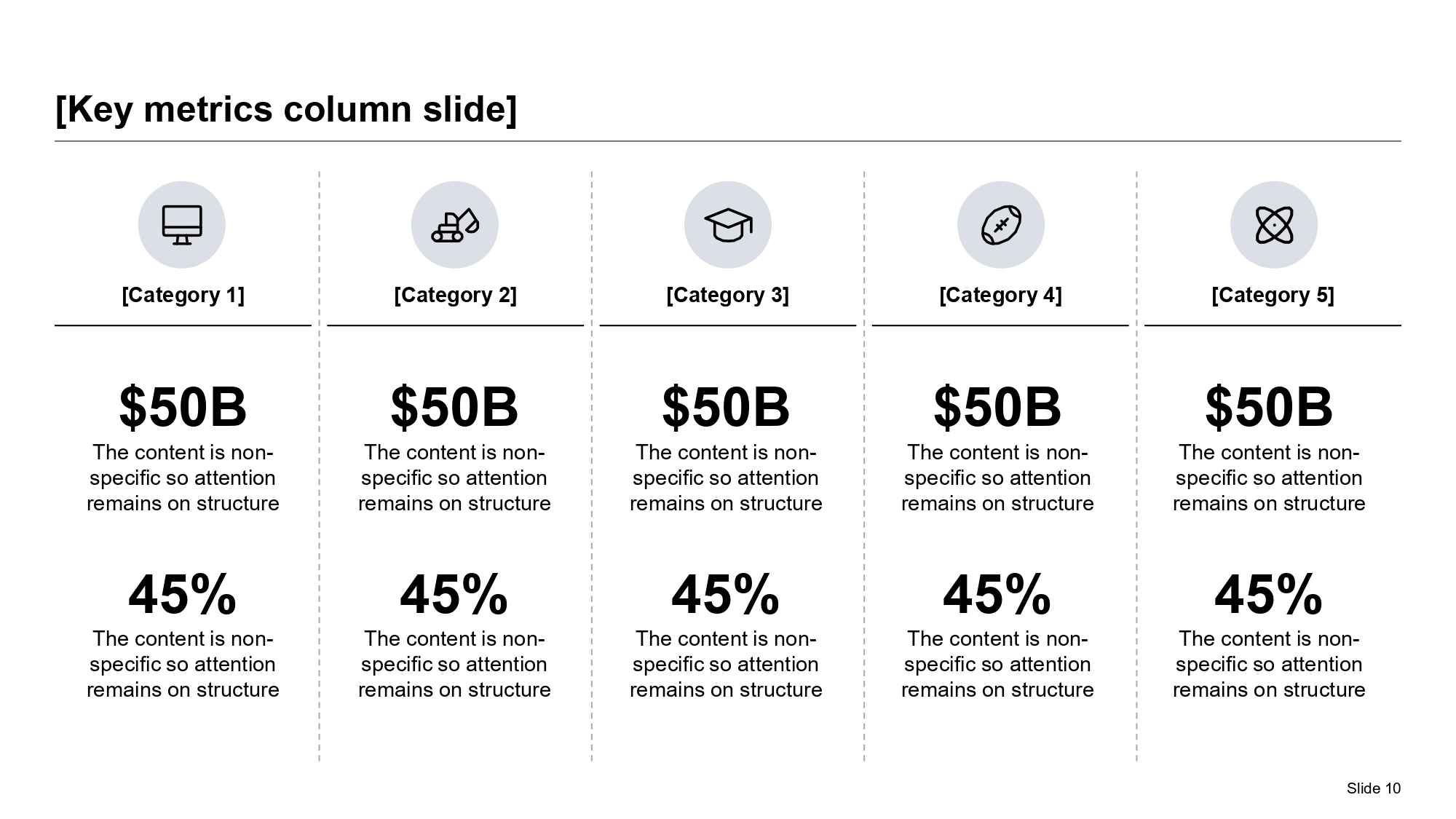
Five-column executive KPI dashboard slide with circular icons, large performance metrics, and compact commentary lanes for talent calibration.
Template Design LayoutPerformance Review Calibration Presentation Template

2Who Should Use This Calibration Template

This template is designed for senior HR and business leaders who need performance decisions to hold up under executive scrutiny. Core users include CHROs, Chief People Officers, HR business partners, talent management leaders, compensation teams, business unit heads, and operating executives preparing for annual or mid-year review cycles. It is also useful for management consultants supporting organization redesign, post-merger talent assessment, leadership bench planning, or pay-for-performance governance. The audience is usually a leadership committee that needs to compare teams, managers, and employee groups using a common standard. In that setting, the page must help leaders distinguish true performance differences from rating inflation, unclear criteria, manager bias, small-sample distortion, or inconsistent promotion thresholds. The deck should make the process feel rigorous without becoming a spreadsheet dump. It is especially valuable when leaders must reconcile local manager judgment with enterprise talent principles, budget limits, and communication risk. That balance is what turns calibration from an HR ritual into a credible executive operating process.

3Recommended Slide Flow for Calibration Meetings

A decision-ready performance calibration deck usually follows a ten-part storyline:

- Slide 1: Executive summary with rating distribution, promotion count, compensation budget, and decisions required.

- Slide 2: Calibration principles explaining the rating scale, evidence standard, and governance rules.

- Slide 3: Workforce overview by function, level, geography, tenure, and critical role group.

- Slide 4: Rating distribution by business unit and manager cohort, highlighting outliers.

- Slide 5: Talent matrix comparing performance, potential, retention risk, and readiness.

- Slide 6: Promotion slate with evidence, role scope change, readiness, and succession impact.

- Slide 7: Merit and bonus guidance aligned to performance rating and budget envelope.

- Slide 8: Bias and fairness review across gender, ethnicity, location, tenure, and manager patterns where data is available.

- Slide 9: Risk register covering regretted attrition, critical roles, low performance, and bench gaps.

- Slide 10: Final decisions, owner actions, communication timing, and documentation requirements.

This flow works because it separates governance, evidence, economics, and final decision rights.

4Rating Distribution Analysis for Executive Confidence

The rating distribution page is often the most important slide in a calibration deck because it shows whether performance standards are being applied consistently. Leadership should see the overall distribution, then compare it by function, geography, level, manager, and role family. Outliers need interpretation rather than automatic correction. A high-performing product team may legitimately have a stronger distribution after a successful launch, while a team with unusually high top ratings but weak business outcomes may indicate rating inflation. The slide should therefore combine quantitative patterns with a short management interpretation. Useful metrics include percentage of employees in each rating band, year-over-year movement, manager-level variance, low-performance identification rate, high-performer retention, and percentage of employees with rating changes after calibration. A strong deck also shows sample-size caveats so leaders do not overreact to small teams. The goal is not forced ranking; it is defensible consistency. Clear annotation matters because executives need to know which variances require intervention and which reflect genuine team performance.

5Talent Matrix Logic for Performance and Potential

Performance calibration becomes more strategic when ratings are connected to future talent decisions. A talent matrix helps leaders compare current contribution against future potential, critical-role readiness, and retention risk. The simplest version uses a nine-box grid, but the executive version should be more precise: define performance evidence, potential indicators, readiness horizon, role complexity, and business impact. A high performer who is not ready for promotion may require stretch assignments, while a high-potential employee with uneven delivery may need coaching before broader scope. The matrix should not become a label exercise. It should produce specific actions, such as promote now, retain aggressively, develop for next role, monitor performance risk, or exit with documentation. Presenting those actions as a calibrated portfolio helps leadership understand talent density at the level of business capability, not just individual employee sentiment. It also creates a practical bridge from annual reviews to succession planning, workforce investment, and manager accountability.

6Promotion and Merit Governance That Reduces Friction

Promotion and merit decisions create the most tension when criteria are ambiguous. A strong calibration deck makes the standard visible before discussing individual names. Promotion pages should show role scope change, sustained performance evidence, leadership behaviors, business impact, readiness timing, and whether the move creates a succession or organization design consequence. Merit and bonus pages should show how budget pools translate into differentiated rewards by rating and market position. A useful executive table might include employee segment, current rating, proposed action, evidence standard, compensation impact, and leadership decision. The page should also identify exceptions, such as critical retention cases, pay equity adjustments, or employees whose role expanded materially during the cycle. By making exception logic explicit, HR teams avoid the perception that calibration is a negotiation between managers rather than a governed decision process. This is also where compensation partners can align financial constraints with talent retention priorities before outcomes are communicated.

7Bias, Fairness, and Data Quality Checks

Calibration is partly a business process and partly a fairness control. Before final decisions are approved, leadership should review whether rating, promotion, and compensation outcomes show unusual patterns by protected class, location, work model, tenure, manager, or role type, using only data the company is allowed and prepared to analyze. The slide does not need to overclaim causality. It should identify patterns that require further review, such as one department assigning materially lower ratings to remote employees, one manager producing unusually narrow distributions, or promotion outcomes diverging from eligible population mix. Data quality also matters. Missing goals, inconsistent job levels, unclear manager ownership, and late performance inputs can distort the process. A credible deck states where the data is strong, where it is directional, and where HR recommends manual review. This approach protects trust and makes the calibration process more defensible. It also helps legal, finance, and people leaders share the same fact base before approving final outcomes.

8A Practical Calibration Scorecard for Leadership

Executives need a small set of measures that summarize whether the review cycle is healthy. The scorecard should balance talent outcomes, process quality, and economic constraints. A compact table can work well:

Calibration MetricWhat It TestsLeadership QuestionExample Action
Rating Distribution VarianceManager consistencyAre standards comparable across teams?Review outlier managers
Promotion Approval RateSlate qualityAre nominations evidence-backed?Defer weak cases
High Performer Retention RiskCritical talent riskWhich top employees need action?Create retention plans
Merit Budget UtilizationEconomic disciplineAre rewards differentiated within budget?Rebalance pools
Fairness Review FlagsGovernance qualityDo outcomes need additional review?Audit specific cohorts

This structure helps leaders see the calibration system rather than debate isolated cases first.

9Design Standards for Executive Talent Review Slides

Performance calibration slides should feel controlled, analytical, and confidential. The `dark-executive` design preset is appropriate because it gives sensitive people decisions a serious operating-review tone. Use compact tables, clear section labels, and restrained accent colors for exceptions, not decorative effects. Avoid oversized employee names in presentation screenshots or examples; use anonymized identifiers where appropriate. Each slide should have one job: rating distribution, talent portfolio, promotion decision, compensation guidance, fairness check, or risk register. Use action titles that state the conclusion, such as 'Engineering ratings require normalization before merit guidance is approved' or 'Two critical-role successors need retention action before Q3.' Keep charts readable by limiting color bands and grouping small teams carefully. The visual standard should signal that leadership is making disciplined decisions based on evidence, not manager advocacy. The deck should look like an operating review, not an employee engagement brochure. This visual discipline helps maintain confidentiality while still making patterns and decisions easy to scan.

10Common Pitfalls in Review Calibration Presentations

The first pitfall is using calibration time to re-litigate every employee review instead of focusing leadership on outliers, exceptions, and decisions required. The second is presenting rating distributions without business context, which can make legitimate high performance look like inflation or weak team performance look like manager bias. Third, many teams treat promotion as a reward for past performance rather than a decision about future role scope and readiness. Fourth, compensation slides often show budget math without explaining pay-for-performance principles, market position, or exception logic. Fifth, fairness checks can be either missing or overinterpreted. The right approach is to show relevant patterns, document review actions, and avoid claims the data cannot support. Finally, weak decks fail to close the loop with communication owners and timing, leaving managers unclear on how to explain outcomes. A strong deck turns each pitfall into an explicit governance question for leaders. Those questions should be resolved before any rating or compensation file is finalized.

11Prompt Recipe for Better Calibration Outputs

High-quality XLSlides outputs depend on a prompt that describes the review cycle, employee population, decision audience, and specific calibration artifacts. A strong recipe is: `Create an executive performance review calibration deck for a 1,200-person software company preparing annual reviews. Audience: CEO, CHRO, CFO, business unit leaders, and HR business partners. Include a rating distribution summary by function and level, manager outlier analysis, nine-box talent matrix, promotion slate with readiness evidence, merit and bonus guidance by rating, pay equity and fairness review, critical-role retention risk register, and final decisions required. Use a dark executive operating-review style with compact tables, KPI scorecards, and clear action-title headlines.` You can improve the output further by asking for a specific table layout, such as a promotion decision matrix, compensation exception tracker, or manager distribution heatmap. Add any rating scale definitions, budget limits, and anonymization rules so the first draft matches your governance model. The more explicit the decision context, the better the generated page hierarchy will be.

12How XLSlides Speeds Up the Calibration Workflow

Most performance calibration decks are built under time pressure from spreadsheet extracts, manager notes, HRIS exports, compensation guidance, and leadership comments. The hard work is judgment, but the formatting work is repetitive: building rating tables, aligning matrices, normalizing headings, creating risk registers, and translating dense review data into executive pages. XLSlides accelerates the first-draft process by turning the calibration brief into a structured presentation with action titles, decision pages, tables, and roadmap sections that can be edited in PowerPoint. HR and strategy teams can then replace placeholders with verified employee data, anonymized examples, and approved compensation numbers. This workflow is useful because it preserves human review where it matters while removing layout friction. Instead of spending hours arranging boxes, the team can focus on fairness, evidence quality, stakeholder alignment, and clear communication of final decisions. The result is a faster, cleaner leadership pack without outsourcing the final people judgment. It also creates a reusable format for future review cycles.