Zero-Based Budgeting (ZBB) Presentation Templates

Stop wasting hours on manual formatting. Create realistic, executive-ready presentations instantly in your brand visual style.

Cost-center & package visualizations
Savings realization trackers
WACC-aligned reallocation models

1The Strategic Paradigm of Zero-Based Budgeting (ZBB)

In traditional corporate finance, budgeting is often an incremental exercise where managers simply adjust the previous year's historical spend by a small percentage. However, in highly competitive markets, this legacy approach hides inefficiencies and institutional waste. Zero-Based Budgeting (ZBB) represents a complete paradigm shift: instead of using historical baselines as a given, ZBB forces finance teams, strategy leads, and business unit managers to build every budget from a zero base at the start of each fiscal period. Under this framework, every single line item and cost category must be justified from first principles, demonstrating direct alignment with the firm's strategic objectives and commercial growth. By shifting the burden of proof from "why should we cut this expense" to "why is this investment necessary for our operations," ZBB establishes a culture of cost ownership and financial discipline. This strategic rigor ensures that resources are allocated to high-performance areas, improving profitability and preparing the firm to execute its corporate strategy with capital efficiency.
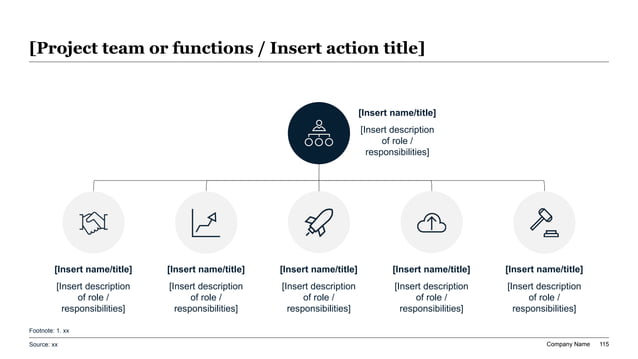
Professional McKinsey-style ZBB slide featuring a 5-function icon-based team structure diagram with a top executive circle and five lower nodes populated with corporate line icons.
Template Design LayoutZero-Based Budgeting (ZBB) Presentation Templates

2Applying Minto's Pyramid Principle to Expense Justifications

When presenting a Zero-Based Budgeting proposal to the board of directors or an investment committee, finance leaders must communicate with extreme clarity. Drowning executives in disorganized spreadsheets leads to decision paralysis and delayed approvals. To avoid this, strategy teams must apply Barbara Minto's legendary Pyramid Principle to structure their justifications. This communication framework dictates that every presentation slide must lead with the conclusion first. Instead of using a passive header like "Travel Expenses," the slide must lead with a clear, active title such as "Consolidating Travel Vendors Reduces SG&A Spend by 18% Without Impacting Key Client Coverage." Underneath this core recommendation, presenters place mutually exclusive, collectively exhaustive (MECE) supporting evidence, including cost-benefit analyses, vendor negotiation roadmaps, and audit logs. This narrative structure allows busy board directors to scan the deck in under ninety seconds, grasp the entire business case, and confidently approve budget allocations. This structured approach prevents layout clutter and ensures that key cost-justification arguments are immediately apparent to stakeholders. By using this hierarchical method, finance teams can efficiently defend their resource requests during aggressive board challenges, securing alignment across departments.

3Establishing a MECE Cost-Center Categorization Model

To implement a successful Zero-Based Budgeting program across a large enterprise, finance teams must establish a rigorous cost-categorization model. The foundation of this system relies on the MECE (Mutually Exclusive, Collectively Exhaustive) framework. This structural standard ensures that every corporate expense is assigned to a specific cost package with zero overlap between categories and no budget items left unassigned. Without MECE discipline, costs can easily be shifted between departments to hide inefficiencies, or double-counted, which ruins the integrity of the audit. By dividing the company's operating expenses (OpEx) into clear, non-overlapping packages—such as facility maintenance, software licensing, third-party consulting, and employee travel—finance strategy leads can audit and benchmark expenditures objectively. This structural classification allows the executive committee to analyze spending habits at a granular level, identify systemic cost drivers, and establish clear accountability across all business units, ensuring that cost control is integrated directly into the corporate operating model. Every manager becomes fully responsible for their designated cost package, eliminating the legacy habit of burying expenses under vague administrative accounts. Furthermore, this classification provides clean, audited datasets that are essential for subsequent automation and AI-driven cost tracking.

4Analyzing Cost Structures Through a High-Density Cost Package Classification

A rigorous ZBB implementation requires classification of all corporate expenses into standardized packages. This high-density cost classification allows finance teams to analyze spending patterns, benchmark performance against industry standards, and establish aggressive cost-reduction targets. By tracking key metrics across departments, the corporate strategy team can spot anomalies and reallocate capital to high-yield business units. The table below outlines a standard enterprise cost package classification model with target reduction benchmarks for corporate strategy leads:

Cost Package CategoryTarget Reduction BenchmarkPrimary Auditing Focus AreaStrategic Reinvestment Objective
Corporate Travel & Entertainment15% to 25%Vendor consolidation and policy enforcementSupport local sales team expansions
IT Infrastructure & SaaS Licensing10% to 20%Underutilized seat recovery and cloud optimizationFund core product engineering R&D
Facilities & Office Footprint20% to 30%Hybrid work model consolidation and sub-leasingReallocate to digital workspace security
External Advisory & Consulting15% to 22%In-sourcing capability audits and rate capsBuild internal corporate strategy teams

Presenting these targets in a clean, visual grid demonstrates deep financial control and gives boards confidence that cost optimization is driven by structured data rather than arbitrary cuts.

5Implementing a Savings Realization and Reallocation Framework

The ultimate goal of Zero-Based Budgeting is not simply to cut costs, but to unlock capital for strategic reinvestment. A successful ZBB framework must include a structured savings realization and reallocation model to ensure that captured funds are directed toward high-value growth initiatives. Rather than allowing saved capital to return to general reserves or be consumed by department-level drift, the executive committee must guide the reallocation process using a prioritized framework. The list below highlights the core strategic steps required to establish a savings realization and reallocation model:

  • Savings Validation Auditing** - Programmatically verify that budgeted cost reductions have actually materialized in monthly P&L statements.
  • Hurdle Rate Assessment** - Evaluate all reinvestment proposals against the company's weighted average cost of capital (WACC) to ensure positive economic value.
  • Strategic Initiative Sourcing** - Channel qualified savings directly into high-growth areas, such as product research, customer acquisition, or digital transformation.
  • Milestone-Based Capital Release** - Fund new initiatives incrementally based on the achievement of specific commercial and operational milestones.

By formalizing this reallocation process, companies transform budgeting from a dry cost-containment chore into a dynamic engine of corporate growth and competitive advantage.

6Constructing a WACC-Aligned Capital Hurdle Rate Model

When reallocating funds saved through Zero-Based Budgeting, finance executives must apply rigorous capital budgeting controls to safeguard corporate resources. A core component of this process is establishing a capital hurdle rate aligned with the company's Weighted Average Cost of Capital (WACC). Every proposal for reinvestment—whether it involves launching a new product line, acquiring a competitor, or upgrading enterprise software—must demonstrate a projected internal rate of return (IRR) that exceeds this cost-of-capital benchmark. Using WACC as the baseline hurdle rate ensures that the firm only invests in projects that generate positive Net Present Value (NPV) and create real shareholder value. Presentation slides detailing these financial hurdle rates must clearly outline the WACC calculation, including cost of equity, after-tax cost of debt, and capital structure weightings. Visualizing these metrics in high-density tables signals to institutional investors and corporate board directors that the management team maintains exceptional financial governance and is committed to disciplined capital stewardship.

7Mapping the ZBB Rollout Timeline with Gantt Roadmaps

Implementing Zero-Based Budgeting across a global enterprise is a complex, multi-quarter initiative that requires careful orchestration and planning. To keep all business unit leaders aligned and on track, strategy teams must map the rollout timeline using a detailed Gantt roadmap. This visual timeline must outline key phases, including training workshops, cost-center audits, zero-base baseline building, budget negotiations, and final steering committee approvals. Visually structuring these phases across quarters helps teams identify critical path dependencies, such as completing the MECE cost classification audit before beginning detailed budget package negotiations. Furthermore, the Gantt roadmap should highlight key steering milestones, such as monthly progress reviews, system integration deadlines, and the final board submission date. Outlining this timeline in a clean, professional slide format reassures stakeholders that the ZBB transition is managed with operational discipline, preventing administrative delays and ensuring a smooth implementation that does not disrupt day-to-day business operations. This timeline serves as the central reference guide for program management offices (PMOs) coordinating the transition. Having a clear visualization of workstream overlaps prevents bottleneck dependencies, ensuring the entire organization transitions to the zero-base system in complete synchronization before the next fiscal year.

8Mitigating Cultural Resistance and Managing Change in ZBB Adoptions

One of the most common reasons Zero-Based Budgeting initiatives fail is cultural resistance from department heads who view the process as a threat to their autonomy and resources. Shifting from an incremental budgeting mindset to a zero-base model requires a comprehensive change management strategy to align incentives and build trust. Finance executives must communicate the ZBB initiative not as a simple cost-cutting exercise, but as a strategic tool to free up capital for high-value growth projects. Business unit leaders must be actively involved in defining their own cost-package benchmarks, transforming them from passive observers into active cost owners. Furthermore, companies should establish incentive systems that reward managers who identify permanent cost savings, aligning personal success with organizational efficiency. Outlining these change management pillars on a structured slide deck proves to the board that the leadership team has addressed the human factors of the transition, reducing implementation risk and ensuring long-term organizational alignment and adoption. Change management plans should include regular town halls and Q&A sessions to address concerns directly. By fostering open dialog and showing how saved funds support the company's future viability, leadership can build a shared commitment to the new financial culture.

9Visual Design Standards for McKinsey-Style ZBB Presentations

To command visual authority and ensure that the board focuses on the strategic merits of your ZBB proposal, your presentation slides must adhere to strict design standards. The "mckinsey-blue" design theme uses a clean, light-grey background canvas to project professionalism and modern design principles. Presenters must maintain a disciplined 60-30-10 color distribution: a 60% dominant background canvas prevents visual clutter, a 30% structured layout grid (using slate-blue card containers) organizes data tables and cost package metrics, and a 10% high-contrast accent key (such as deep royal blue) highlights key savings figures and timeline milestones. All text containers, metrics cards, and graphics must align perfectly to a 12-column visual grid, avoiding layout drift. Furthermore, keep typography disciplined: limit the deck to exactly two font families, keeping slide headings at 24pt-28pt, subheadings at 16pt-18pt, and body text at 12pt-14pt. Protecting at least 30% negative space on every slide lets the content breathe, reducing cognitive friction and ensuring visual excellence across all projectors and digital screens. This design structure ensures that slides remain highly readable even when presented in large boardrooms with ambient light. It establishes a premium brand image for the finance function, highlighting the rigorous analytical quality of the ZBB findings.

10Leveraging XLSlides AI to Automate Cost-Center Slide Creation

Creating a comprehensive Zero-Based Budgeting presentation manually in PowerPoint is a slow, frustrating task that often consumes 12 to 16 hours of adjusting margins, aligning data grids, and formatting financial tables. This administrative overhead drains valuable cognitive energy that strategy and finance teams should instead spend analyzing cost centers, optimizing vendor agreements, and identifying reinvestment opportunities. XLSlides AI automates this layout design process, allowing finance analysts and strategy leads to compile premium, boardroom-ready ZBB decks in under sixty seconds. The AI performs context-aware layout matching, interpreting your cost-center brief and automatically mapping data to visual timelines, MECE allocation grids, or cost package comparison cards. Brand consistency is strictly maintained based on your chosen design preset, preventing font or margin drift. The final presentation exports as standard, editable PowerPoint vector shapes, allowing you to easily adjust budget numbers, update financial charts, or customize slides for specific committees, providing a major efficiency boost to corporate finance teams. This workflow transformation frees up valuable analyst resources to focus on high-impact variance analysis and business partnering, raising the overall maturity level of the corporate finance department while reducing the cost of presentation creation.