Talent Acquisition & Strategic Recruiting Templates

Stop wasting hours on manual formatting. Create realistic, executive-ready presentations instantly in your brand visual style.

Employer brand visualizations
Recruitment funnel dashboards
Tech-stack enablement roadmaps

1The Strategic Imperative of Talent Acquisition in Corporate Strategy

In the modern corporate landscape, establishing a highly competitive talent pipeline has transitioned from an operational human resources task to a critical board-level strategic driver. Strategy consulting partners, chief human resources officers, and corporate strategy directors recognize that enterprise growth is ultimately limited by the speed and quality of team scaling. Underinvesting in recruiting engines leads to delayed product launches, stalled market expansions, and key role vacancies that drag down overall capital efficiency. By designing a structured talent acquisition strategy for 2026, companies can align hiring velocity with long-term revenue targets. This system allows leadership teams to project future workforce capacity, model operational headcount budgets, and defend talent investments to institutional investors. Presenting these plans in a boardroom-ready 16:9 widescreen presentation deck is essential to secure budget approvals and align business unit steering committees. The following list highlights the primary strategic goals of a corporate talent pipeline:

  • Scalable Capacity**: Aligning hiring pipelines directly with product launch schedules.
  • Capital Efficiency**: Optimizing acquisition costs across agencies and direct channels.
  • Talent Density**: Increasing the proportion of high-performing leaders in key roles.
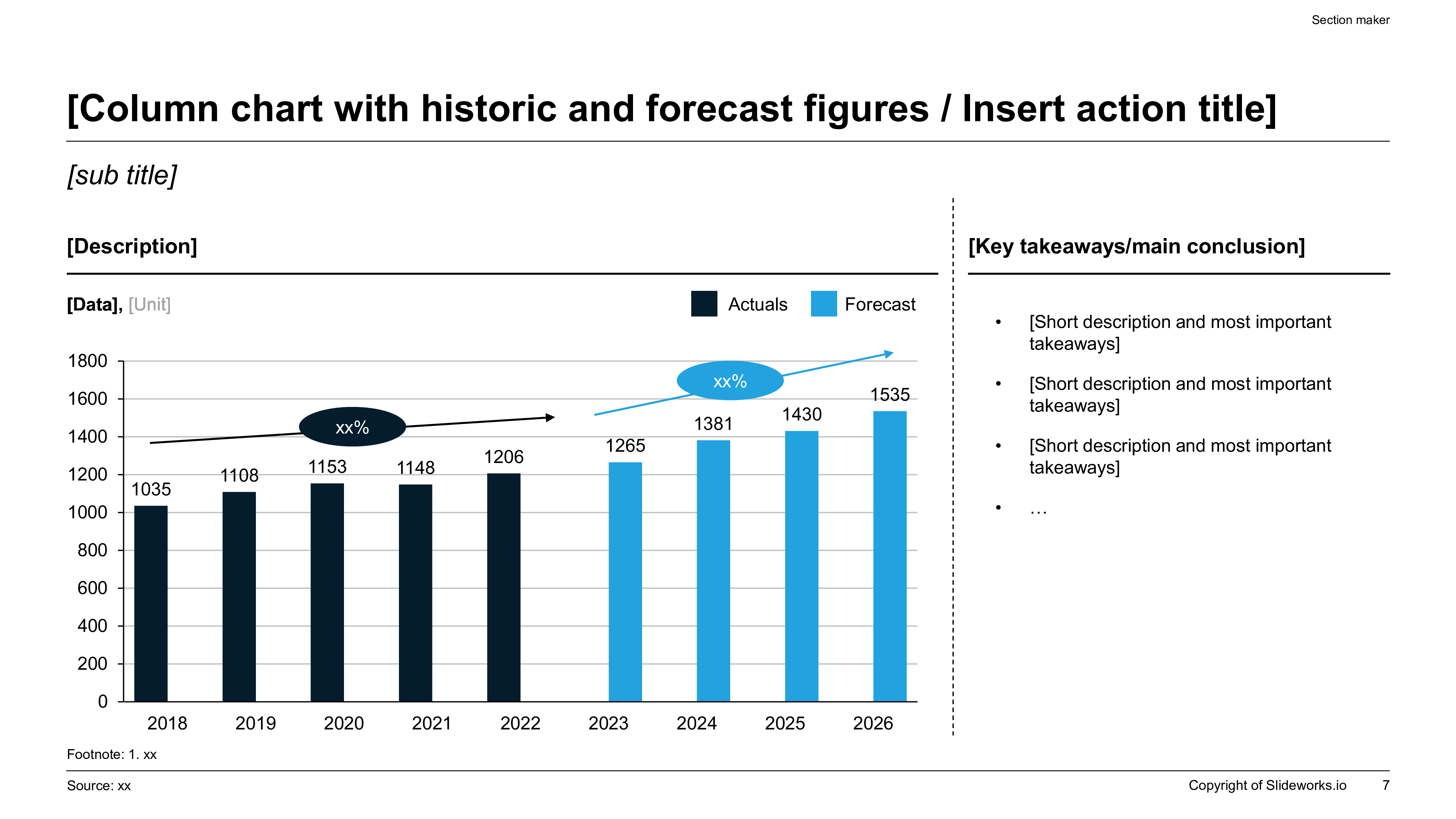
Widescreen slide featuring a dual-colored column chart comparing annual metrics with dark navy columns for historical actuals and light blue columns for forecast estimates.
Template Design LayoutTalent Acquisition & Strategic Recruiting Templates

2Structuring the Candidate Journey Using Minto's Pyramid Principle

To secure executive alignment and steering committee sponsorship for talent expansion budgets, presentations must be structured using Barbara Minto's Pyramid Principle. This communication standard requires leading with the primary conclusion first, where every slide headline delivers an active, strategic takeaway rather than a passive label. For example, instead of titling a slide 'Recruitment Overview,' a strategy partner should write: 'Automated sourcing tools reduce time-to-hire by twenty-four percent while increasing candidate quality.' Under this primary claim, you group supporting evidence into mutually exclusive and collectively exhaustive (MECE) sub-arguments. This narrative discipline ensures that busy board directors can digest the strategic significance of the talent pipeline in under ten seconds. By storylining your presentations around active executive decisions and clear operational thresholds, you shift the boardroom conversation from debating background recruiting metrics to aligning on corporate resource allocation and hiring velocity:

  • Conclusion First**: Lead every slide with a clear, quantified takeaway.
  • MECE Supporting Arguments**: Group recruiting data into non-overlapping strategic pillars.
  • Executive Alignment**: Focus on business results rather than operational details.

3Designing a MECE Recruiting Funnel for Boardroom Reporting

A granular understanding of talent acquisition efficiency requires mapping the candidate journey through a structured recruiting funnel. Applying a MECE (Mutually Exclusive, Collectively Exhaustive) framework ensures that every candidate is assigned to a single funnel stage with zero overlap, preventing data leakage and ensuring analytical integrity. This structural discipline is critical for isolating conversion leakage points, such as high drop-out rates during technical assessments. Presenting these conversion metrics in a structured visual format helps board members identify operational bottlenecks and evaluate overall recruitment health. By standardizing this funnel reporting model, companies can prioritize candidate experience improvements, optimize sourcing budgets, and align HR teams around key hiring milestones. The list below highlights the primary stages of a boardroom-grade recruiting funnel:

  • Sourcing and Attraction**: Upper-funnel candidate discovery, employer branding, and initial application metrics.
  • Screening and Evaluation**: Mid-funnel hiring manager reviews, initial calls, and skills assessments.
  • Interview and Selection**: Deep-dive team evaluations, panel interviews, and final stakeholder alignment.
  • Offer and Onboarding**: Lower-funnel offer extensions, negotiation, background checks, and team integrations.

4Quantitative Recruiting Metrics and LTV-to-CAC Alignment

To justify talent acquisition budgets to finance partners and private equity operating leads, HR executives must present a clear, quantitative performance model. Measuring cost-per-hire against employee lifetime value (LTV) demonstrates that your talent strategy is driving long-term enterprise value rather than representing a simple cost center. A healthy talent acquisition engine targets channels that deliver the lowest cost-per-hire and the highest long-term retention. The data table below outlines a standard talent sourcing channel performance matrix designed for strategy leads and finance directors:

Sourcing ChannelAverage Cost-Per-HireTime-to-Fill (Days)1-Year Retention RateChannel Quality Score
Executive Search Agencies$25,00075 Days88%Exceptional
Employee Referral Program$3,50030 Days92%Outstanding
Direct LinkedIn Sourcing$1,20045 Days78%High
Online Job Portals$80060 Days64%Moderate

Presenting these metrics in a clean visual table format demonstrates deep operational control and gives board members confidence that capital is allocated efficiently across recruiting channels.

5Building a Boardroom-Grade Employer Value Proposition (EVP)

A strong Employer Value Proposition (EVP) is the cornerstone of any talent strategy, serving as a competitive shield against talent poaching and rising compensation demands. In 2026, corporate strategy teams must align culture, compensation, and career pathing to attract top-tier talent without inflating operational costs. Proposing a structured EVP framework to the board demonstrates that you are addressing candidate expectations systematically rather than reactively. This strategy helps reduce employee turnover, increases offer acceptance rates, and builds a sustainable talent brand. The checklist below highlights the critical pillars required to construct an effective employer value proposition:

  • Total Rewards Calibration**: Balancing base salary, performance bonuses, and equity to align employee incentives with shareholder value.
  • Career Growth Mapping**: Defining transparent promotion tracks and skill development pathways to foster long-term loyalty.
  • Flexible Work Model**: Standardizing hybrid rules and digital workspace tools to attract talent globally while preserving company culture.
  • Purpose and Alignment**: Communicating corporate mission and environmental, social, and governance (ESG) commitments to engage candidates.

6Phased HR Tech Stack Integration and Implementation Roadmap

A target recruiting model cannot achieve its efficiency targets without modern HR technology enablement. System architects and talent acquisition leads must design a phased integration roadmap that synchronizes software rollouts, applicant tracking systems (ATS), and AI-driven candidate sourcing tools. This technology roadmap must define critical dependencies, such as standardizing data schema in your ATS before integrating automated screening algorithms. Outlining these dependencies on a structured, widescreen timeline slide helps stakeholders visualize the sequence of key milestones. The list below summarizes the critical execution phases for HR tech enablement:

  1. 1Phase 1: Sourcing Automation - Deploy AI candidate discovery tools and standardize job description templates.
  2. 2Phase 2: ATS Migration - Consolidate regional candidate databases into a unified applicant tracking system.
  3. 3Phase 3: Analytics Integration - Connect HR metrics with corporate financial dashboards to track onboarding ROI.

Following this structured roadmap minimizes implementation downtime and protects business continuity during system rollouts.

7Diversity and Inclusion Metrics Calibration for Leadership Calibration

To ensure the executive committee reviews talent acquisition strategies with absolute clarity, talent teams must establish clear diversity calibration rules. Tracking gender, ethnic, and background diversity metrics across the recruiting funnel is essential to identify potential biases and build a high-performance, inclusive culture. The table below represents a standard diversity pipeline calibration map for executive roles:

Recruitment Funnel StageFemale Candidate ShareUnderrepresented Group SharePipeline HealthAction Plan
Initial Sourcing Pool45%30%HealthyMaintain direct outreach
First-Round Interview40%25%HealthyStandardize screening questions
Final Panel Interview35%20%Review NeededRequire diverse interviewer panels
Offer Extended30%15%Action RequiredCalibrate compensation parity

Monitoring these metrics at each stage helps corporate boards make data-driven decisions that align hiring with corporate governance commitments and long-term societal expectations.

8Mitigating Workforce Retention Risks in High-Stakes Transitions

Redesigning talent acquisition workflows or undergoing corporate restructuring introduces significant operational risks, including employee anxiety, productivity loss, and key talent attrition. Business transformation leaders must proactively manage these risks by constructing a clear change management plan. This strategy must outline comprehensive employee training schedules, leadership alignment workshops, and transparent, open communication channels. Talent leads must monitor key retention indicators—such as employee engagement scores, project milestone completion rates, and average tenure—to identify change resistance early and intervene before it impacts performance. Presenting a risk assessment matrix alongside your talent strategy proposal shows stakeholders that you have planned for operational contingencies. Highlighting key mitigation actions, like establishing peer mentorship programs or offering retention bonuses during system migrations, reassures the board of directors that workforce transition risks are actively managed. This proactive risk mitigation plan is essential to safeguard business continuity, maintain stakeholder confidence, and ensure that the organization realizes the projected efficiency gains and operational synergies of the new talent model. By prioritizing the human element during transformation lifecycles, companies protect their culture and sustain long-term growth objectives.

9How to Generate Widescreen Talent Strategy Slides with XLSlides AI

Designing corporate presentations manually in PowerPoint is a slow, tedious process that often costs strategy teams and HR analysts 12 to 16 hours of formatting work. Adjusting text box margins, aligning recruitment tables, and styling candidate journey curves manually is an inefficient use of valuable resources. XLSlides AI automates this layout design process, allowing strategy partners to generate premium, boardroom-ready talent strategy presentations in under 60 seconds. The AI engine performs intelligent, context-aware layout mapping, translating your recruiting narrative and channel tables into structured column cards, comparison curves, and timeline matrices. Design parameters are automatically locked to your chosen style preset, preventing font or margin drift. The completed presentation exports as fully editable PowerPoint vector shapes, allowing you to easily adjust schedules, customize copy, or import company-specific branding. By transforming the presentation workflow, teams can allocate their analytical energy to interpreting candidate data and executing growth initiatives rather than fighting slide margins:

  • Instant Generation**: Build complete talent decks in under 60 seconds.
  • Pixel-Perfect Alignment**: Grid-aligned components eliminate formatting errors.
  • PowerPoint Compatibility**: 100% editable vector shapes for easy customization.

10Copy-Pasteable Prompt Engineering Recipe for Talent Strategy Decks

To help corporate advisors, management consultants, and talent leads generate high-impact recruiting strategy presentations instantly, our AI models support optimized prompt recipes. Providing a detailed, context-rich instruction set to the AI presentation builder eliminates hours of tedious manual formatting. Our AI understands structured HR syntax and automatically converts raw text instructions into clean visual components, such as recruitment funnels and channel performance tables. Below is a highly optimized, copy-pasteable prompt engineering recipe tailored for this talent strategy template:

```text

Generate a professional corporate Talent Acquisition Strategy presentation using the Minimal-Modern design preset. The deck must include a 4-step recruitment funnel analysis (Sourcing, Screening, Interviewing, Onboarding), a sourcing channel performance comparison table, a talent retention risk matrix, and a 3-phase ATS implementation timeline roadmap. Keep margins aligned to a 12-column grid and include high-contrast slate accent elements.

```

Using this recipe ensures the AI applies correct grid alignments, mapping your candidate metrics to appropriate visual layouts in under 60 seconds.