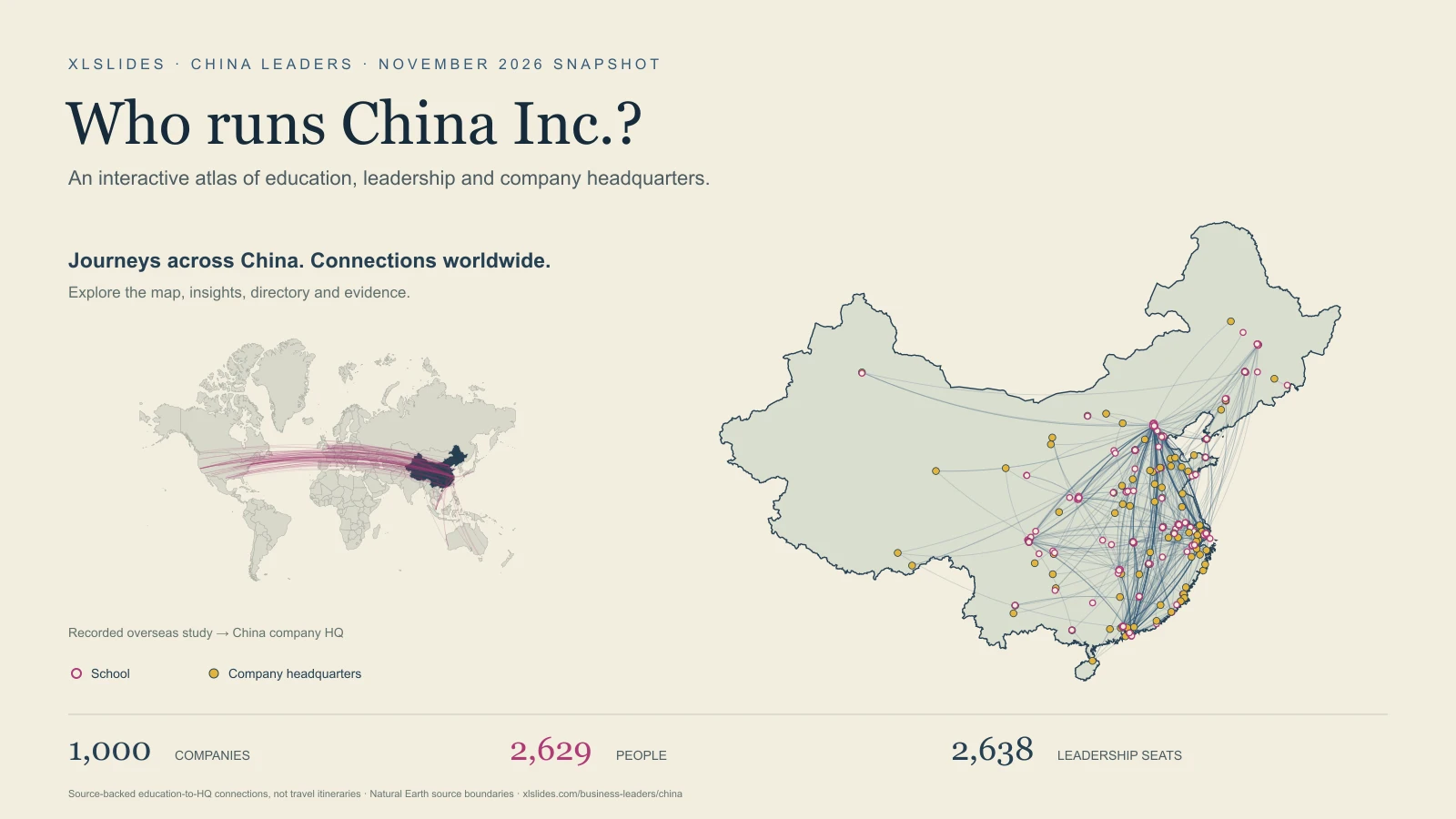
Read a journey
Search for a leader, company or college. Select a result to see education stops and the company headquarters. The role controls distinguish CEOs, CFOs and chairs. The directory opens a selected leader’s journey; the insights compare educational backgrounds and career paths using the original charts.
Lines connect recorded education locations to headquarters. They are illustrative connections, not residential addresses, travel histories or a complete chronology of employment. Institutions and headquarters within a city are fanned out so logos can be selected. City-level points should not be read as precise building locations.
Count people and seats separately
The imported dataset contains 2,638 leadership-seat records and 2,629 distinct people across 1,000 companies. A person who holds several seats can appear at several companies. The original charts distinguish person-level and seat-level comparisons; their denominators should remain attached to the statistic.
2,559 distinct leaders (97%) have known education or professional qualifications, and 986 have a named college or university. 986 have education stops placed in the journey data. Of the leaders with known education, 180 (7%) studied abroad and 342 (13%) hold an MBA.
Keep the snapshot and confidence visible
This is the owner’s November 2026 research, imported on 13 November 2026. It is not a live source of appointments or index membership, and the company universe is the source project’s, not a claim that current constituents have been rechecked.
Inherited confidence labels for distinct leaders are high (904), medium (1,699), low (26). The selected profile retains its source link and confidence. “Not disclosed” means the research did not establish that detail; it does not prove that a person has no degree or qualification. Educational associations do not establish that a credential caused career success.
Sources and attribution
Profile records retain the owner’s cited company leadership pages, annual reports, filings, reference pages and business reporting. Evidence quality and dates vary. Check a company’s current filing or leadership page before relying on a role for a current decision.
- Natural Earth: Public-domain geography; the original app uses India point-of-view boundaries.
- Wikidata: Headquarters and college locations for most studies.
- Profile evidence: Company leadership pages, annual reports, appointment filings and other sources retained in individual research records. Source quality varies.
Company and college marks identify their respective organisations; their presence does not imply endorsement. Original logo credits remain in the source index.
Download the leadership snapshot ↗How this study was built
November 2026 research snapshot. Imported by XLSlides on 13 November 2026. This is a dated study of the companies described below, not a live appointment tracker or a claim that every profile has been independently reverified. Confidence varies by record. A person can hold multiple seats; missing education is not evidence of having no qualification.
Companies are the 1,000 largest China A-share companies (Shanghai, Shenzhen and Beijing exchanges) by total market value on 5 November 2026. This is a market-value ranking, not an index: the official CSI 1000 index covers smaller companies (ranks 801 to 1,800). Companies listed only in Hong Kong or the US, such as Tencent and Alibaba, are not A-shares and are not included. Top 100 and 101–300 mark the largest companies.
For each company we recorded the Chair of the board (董事长), the CEO (总经理, 总裁, or 行长 at banks) and the CFO (财务总监, 财务负责人 or 首席财务官), as listed in November 2026. Leaders, education levels and résumés come from the résumés companies must publish for their directors and executives, as collected by Eastmoney's company pages (F10). The same person on several boards is matched by Eastmoney's person code. Names are given in pinyin with the Chinese characters.
Chinese résumés state the education level for nearly everyone, but often not the university or the subject; state-owned companies in particular write "university education" or "master's degree" without naming the school. Where a résumé doesn't say, it shows as not disclosed. Where the first degree's subject isn't stated, the subject of the next degree named is used (never an MBA). Party schools (the Central Party School and provincial Party schools) are counted as named institutions; their degrees are in-service study.
To compare with the other countries, each first degree is also placed in the Indian school stream it belongs to. STEM matches science, business matches commerce, and liberal arts matches arts (economics, humanities, social science, law). CPAs include Chinese CPAs (注册会计师), ACCA members and US CPAs. The C9 League are China's nine elite research universities: Peking, Tsinghua, Fudan, Shanghai Jiao Tong, Zhejiang, USTC, Nanjing, Harbin Institute of Technology and Xi'an Jiaotong. Degrees from Hong Kong, Macau and Taiwan count as outside mainland China. Communist Party membership is counted only where the résumé states it.
Headquarters are placed at the city in the company's disclosed office address. University English names and locations come from Wikidata. A city's companies and universities are fanned out around the city centre so their logos don't stack; those positions inside a city are illustrative.
Logos are the companies' and universities' own marks, taken from Wikimedia Commons or the organisation's website icon, and are shown only to identify them. Where none was found, initials stand in.
Boundaries, province names and city names come from Natural Earth (public domain); boundaries follow India's official view.