XLSlides
A former McKinsey chief before MPs
On Wednesday 1 February 2023, Dominic Barton appeared before the House of Commons government operations committee in Ottawa, voluntarily and as a private citizen. He had been McKinsey’s global managing partner from 2009 to 2018 and was later Canada’s ambassador to China. In his statement, he said he had had “no involvement whatsoever” in any awarding of paid work to McKinsey by the federal government since he relocated to Asia in 1996. He was there because Ottawa’s spending with McKinsey had soared. This case follows that spending through three reviews, and sets out what each of them did and did not find.
Source context: [7]
The client
The client was the Government of Canada. Governments do not earn profits; they spend public money, and they buy a great deal of advice. According to the Auditor General, as reported by CBC News, federal departments and agencies awarded about $4.5 billion in professional services contracts in 2015-16, in the categories where McKinsey offers comparable services, and more than $8.4 billion in 2021-22.
The rules are meant to protect that money. Competition is the default, and exceptions need a written justification. Each contract file should show what the government needed, what it was buying and whether it received it. McKinsey sells advice by the team, for a fee; its clients pay for experienced people, speed and global experience.
The spike
According to the Auditor General, McKinsey won less than $3 million a year in federal work until 2014-15. In 2015-16, the fiscal year in which the Liberal government took office, the figure reached $10 million, and by 2021-22 it was more than $55 million a year. In January 2023, Radio-Canada reported the rise. According to Global News, the procurement department confirmed 23 contracts since 2015 worth $101.4 million, 20 of them sole-sourced, and Radio-Canada put the total for the nine years of the previous Conservative government at $2.2 million. There was also a connection: from 2016, Barton had chaired the finance minister’s Advisory Council on Economic Growth.
The hearing
Prime Minister Justin Trudeau said the government would follow up to ensure the work “was done the right way”. On 18 January 2023, the Commons committee voted unanimously to investigate. At the hearing, Barton said he was not a friend of the Prime Minister: “I have a professional relationship.” He said he had met Trudeau perhaps a dozen times, including through the growth council, which McKinsey had supported pro bono, and that procurements were evaluated by civil servants, not politicians. He also put the money in context, citing a National Post report that the government had spent at least $22.2 billion on outside consultants in the year to March 2022, of which McKinsey’s share was $17 million.
The first verdict
The government ordered its own review. In June 2023, the Treasury Board Secretariat and Public Services and Procurement Canada reported that the integrity of the procurement process had been maintained, and found no conflict-of-interest non-conformity involving public servants, public office holders or McKinsey. They identified areas for improvement in record management and contract administration. Part of the story was a special arrangement. In 2021, the procurement department set up a national master standing offer for McKinsey’s proprietary benchmarking services, tools and databases that let organisations compare their performance. It was established without competition, and 19 contracts were issued under it before it expired in February 2023.
The ombud
Next came the Procurement Ombud, Alexander Jeglic. In April 2024, he published a review of 32 McKinsey contracts with a total amended value of about $112.8 million. He found that the standing offer “may have been improperly established on a non-competitive basis”, because the justification documents lacked the required information, and that most orders under it were “void of any description of the requirement-specific work”. In two cases, he found, the process was altered in a way that enabled McKinsey to bid.
“Collectively, these observations create a strong perception of favouritism towards McKinsey,” he wrote. The procurement department replied that it had “no direct evidence” of favouritism, and its deputy minister noted that the Ombud had found “no instances of political interference, no wrongdoing and no fraud”.
Make every contract file answer three questions
- 01Why this supplier?
Record the need and, for any non-competitive award, a justification that meets the policy’s requirements.
- 02What will be delivered?
Define the requirement-specific work and deliverables before the order is issued.
- 03Was it received?
Keep evidence of what was delivered, and pay only after the work is done.
The audit
On 4 June 2024, Auditor General Karen Hogan tabled her report. Her team examined every McKinsey contract awarded from 1 January 2011 to 7 February 2023 by 10 departments and agencies and 10 Crown corporations: 97 contracts, $208.7 million awarded and $200.3 million spent. “We found that organizations awarding the contracts showed a frequent disregard for federal contracting and procurement policies and guidance,” she said.
Sixty-nine of the 97 contracts were non-competitive. In four of the 28 competitive ones, the procurement strategy appeared to be designed and implemented to suit McKinsey. National Defence asked the firm to invoice before work was completed on two contracts in 2021, which the auditors said contravened the Financial Administration Act. In 19 of the 33 contracts sampled, the organisations could not demonstrate that they had received value for money.
Follow the money
Of the $209 million, $117.7 million was awarded without competition. About $58 million came as follow-on work awarded without competition after McKinsey had won an earlier contract, a pattern the auditors said “may be perceived as an overreliance” on one supplier. The problems were not confined to one government or one organisation: non-compliance appeared throughout the 12-year period and in almost all of the organisations audited. Hogan told a committee, according to CBC News, that about $8.6 million of the spending occurred under the former Conservative government, a wider count than Radio-Canada’s because it includes Crown corporations. McKinsey received about 0.27% of payments to all suppliers in these service categories from 2011 to 2023. The issue was not the size of the bill, but whether anyone could show what it bought.
The other side
No one was charged. The reviews concerned how public bodies followed their own rules, and none found wrongdoing by McKinsey. Hogan said she “didn’t see any ministerial involvement” in directing contracts to the firm. A McKinsey spokesperson said the report did not say the company had acted inappropriately: “We stand by our work and are confident that we both satisfied the needs of our government clients and delivered value for money.” Barton has denied any role in the contracts.
The government accepted the recommendations. The minister, Jean-Yves Duclos, said documentation must now be kept on file, and the criteria for standing offers were improved. The procurement department also accepted the Ombud’s recommendations.
THE SEQUENCE
A timeline of the case
Under $3m a year
McKinsey’s annual federal awards stay small until 2014-15. [2]
Barton chairs the growth council
He leads the finance minister’s Advisory Council on Economic Growth. [9]
Benchmarking standing offer
A sole-sourced national master standing offer for McKinsey benchmarking services; 19 contracts follow. [5]
Spending becomes news
Radio-Canada reports the rise; the Commons committee votes unanimously to investigate. [9]
Barton testifies
He denies any involvement in awarding federal work to McKinsey. [7]
Government review
Procurement integrity maintained; record keeping and contract administration need improvement. [6]
Procurement Ombud
A “strong perception of favouritism”; the department says it has no direct evidence. [3]
Auditor General’s report
“Frequent disregard” for policies; value for money not shown in 19 of 33 sampled contracts. [1]
Three reviews, three different questions
The Canadian record is unusual because three separate reviews looked at the same contracts. The 2023 government review asked whether procurement integrity and conflict-of-interest rules had been respected, and found that they had. The Procurement Ombud asked whether specific procurements were fair, and reported a strong perception of favouritism. The Auditor General asked whether organisations followed policy and could show value for money, and found frequent disregard for the rules and missing evidence of value.
These findings are not contradictory. They answer different questions with different evidence. A process can be free of conflicts of interest and still poorly documented. A perception of favouritism can exist without proof of favouritism. And a contract can be delivered without the file showing that it was. Reading the reviews together, rather than choosing the most dramatic headline, gives the clearest picture: the problem was mainly how public bodies bought advice, not what McKinsey did. The audit committee presentation guide recommends presenting findings by question and evidence type for exactly this reason.
Non-competitive awards need stronger files
Sixty-nine of the 97 contracts were awarded without competition, worth about $117.7 million. Non-competitive contracting is lawful when the conditions are met: a genuine sole source, an urgent need or a proprietary product. The McKinsey benchmarking standing offer was justified on the basis that the services were proprietary. The Ombud found that the justification documents lacked the required information.
The lesson for public buyers is that a non-competitive award needs a stronger file than a competitive one, not a weaker one. Competition produces its own evidence: bids, evaluations and a winner. Without competition, the only evidence that the price and the choice were right is the justification. If that is thin, the buyer cannot defend the decision later. The strategic sourcing and procurement presentation guide covers how to present sourcing decisions so that the rationale is visible.
Follow-on work is where dependency grows
About $58 million came as follow-on work awarded without competition after McKinsey had won an earlier contract. The auditors warned that this may be perceived as overreliance on one supplier. Follow-on awards are attractive for good reasons: the firm already knows the organisation, the data and the people, and switching suppliers takes time. Each individual extension can be sensible.
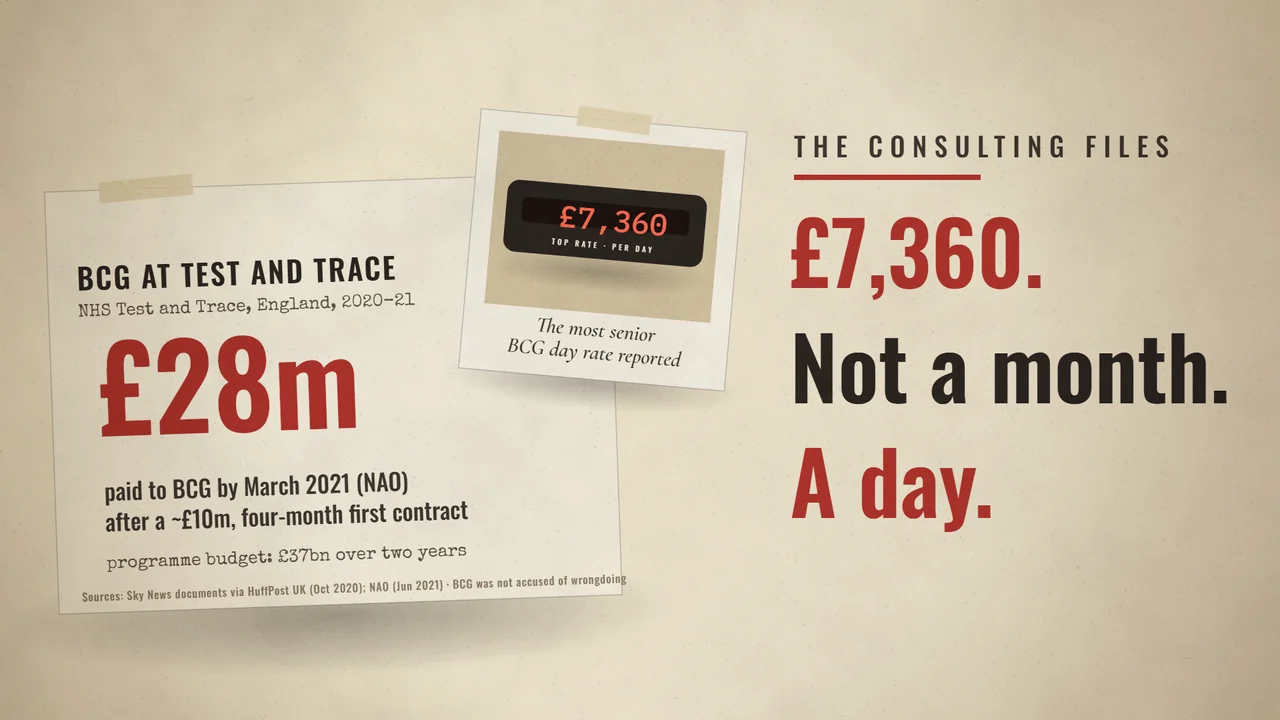
The risk is cumulative. A chain of small, reasonable extensions can produce a large, unplanned dependency that no one ever decided to create. Buyers can manage that risk by setting a ceiling on follow-on value relative to the original award, requiring a fresh justification once it is reached, and tracking total spend with each supplier across contracts. The Test and Trace day-rate case shows the same pattern in an emergency setting, where a four-month engagement grew to roughly three times its first value.
Value for money must be evidenced, not assumed
In 19 of the 33 contracts sampled, the auditors could not tell whether the government received what it paid for. That is the finding with the most practical consequences. It does not mean the work was poor. It means the files did not record clearly what was required, what was delivered and how it was used.
For consultants, this is a risk even when the work is good. If the client cannot show what it received, the firm’s name will appear next to the phrase “value for money not demonstrated”. Firms can protect themselves and their clients by agreeing written deliverables, confirming acceptance at the end of each phase and keeping a short record of how the output was used. An executive summary slide generator can help turn each deliverable into a one-page record of the decision it supported.
Invoices follow work, not budgets
The auditors found that National Defence asked McKinsey to invoice before work was completed on two contracts in 2021, which they said contravened the Financial Administration Act. Requests like this usually come from budget pressure: money that is not spent by year-end may be lost. From the client’s side, it can look like efficient use of an allocation. From an auditor’s side, it is payment without evidence of delivery.
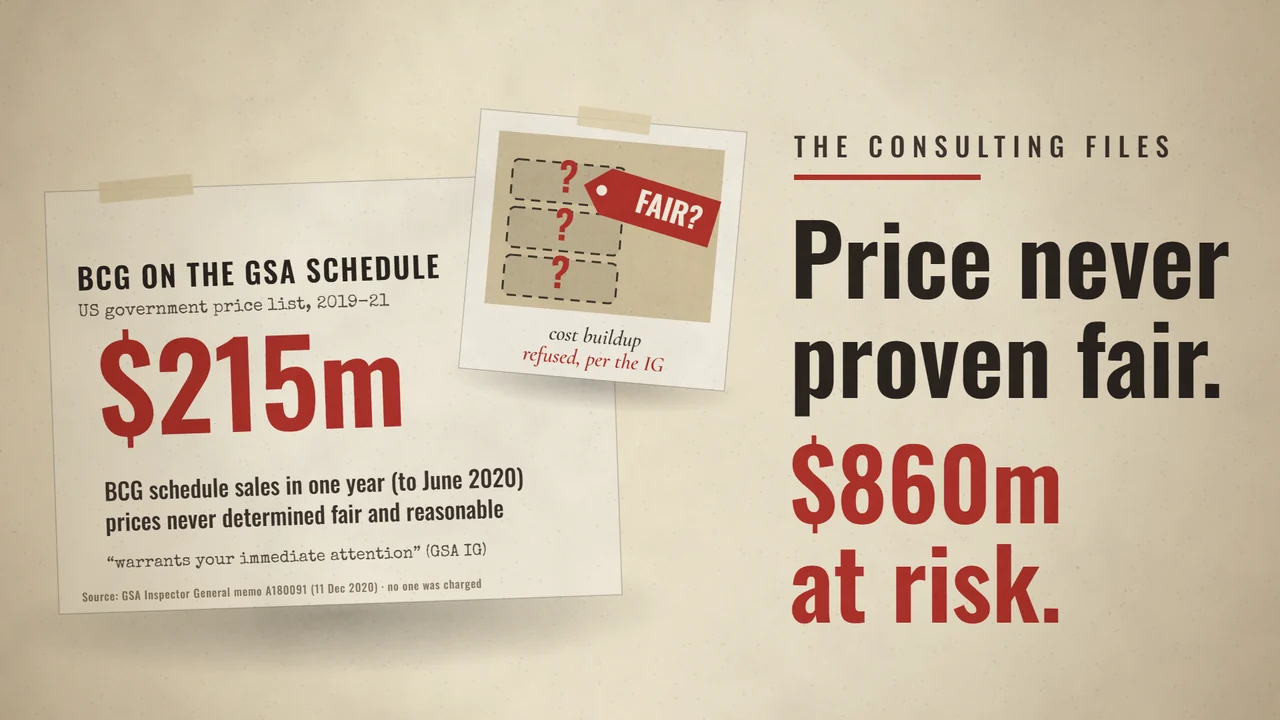
A supplier that receives such a request should decline it or escalate it, even if the client is insistent. The short-term convenience is not worth the audit finding. The same principle appears in the BCG GSA pricing case, where every exception to the normal process was later quoted in a watchdog memo.
Relationships create perception risk
Dominic Barton’s role as McKinsey’s former global managing partner and chair of the finance minister’s growth council was a large part of the public story. He told MPs that he had no involvement in awarding federal work to McKinsey, and none of the reviews found political interference; the Auditor General said she saw no ministerial involvement. The Ombud’s favouritism finding was explicitly a perception finding, which the procurement department disputed.
Perception still matters. When a firm’s former leader advises ministers and the firm’s federal business grows sharply at the same time, the public will connect the two whether or not there is a causal link. Firms can reduce this risk by keeping advisory roles and pro bono work visibly separate from procurement, recording any contact between senior figures and buyers, and declining to rely on relationships as a selling point in public work. The France consulting-spend case shows how the same perception problem can grow into a political controversy.
Scale is not the point
McKinsey’s share of federal spending in the relevant categories was about 0.27% from 2011 to 2023. Its $209 million is small next to more than $8 billion a year of professional services spending. Barton made that point to MPs, and it is accurate.
It does not change the lesson. The audit was not about the size of the bill but about whether anyone could show what it bought. The same documentation gaps were found across almost all the organisations audited and throughout the 12-year period, under both governments. That suggests the problem lies in how the federal system buys advice, not in one supplier.
The paper trail is the deliverable
The most practical conclusion from the Ottawa contracts is that, in public work, the paper trail is part of the product. A strong report delivered without a record of why it was needed, what it was meant to produce and how it was used will not survive an audit. For consultants working with public bodies, that means helping the client build the file as the work proceeds: a clear requirement, a defined deliverable, an acceptance record and an invoice that follows the work. The rules belong to the client, but when they are not followed, the risk is shared.
TAKE IT INTO THE NEXT MEETING
Three practical lessons
The client’s rules are your risk too
A shortcut in a public buyer’s paperwork can end up in a headline with your firm’s name on it. Ask how the contract was justified before you sign.
Build the paper trail as you go
Document the need, the deliverables and the evidence of delivery for every order. Do not invoice before the work is done, even when a client asks.
Relationships can look like a reason
Former leaders, advisory councils and pro bono work are legitimate, but they create perception risk. Keep them visibly separate from procurement.
Questions about the case
Did the Auditor General find wrongdoing by McKinsey?
No. The audit examined how federal organisations awarded and managed the contracts. It found frequent disregard for policies but made no finding of wrongdoing by McKinsey, and the Auditor General said she saw no ministerial involvement in directing contracts to the firm.
How much did Canada pay McKinsey?
The Auditor General counted 97 contracts worth about C$209 million awarded from January 2011 to February 2023, of which about C$200 million had been spent. Earlier figures, such as $101.4 million since 2015, covered fewer organisations or shorter periods.
What did the Procurement Ombud find?
He found that a sole-sourced standing offer for McKinsey benchmarking services may have been improperly established, that most orders under it lacked a description of the work, and that his observations collectively created a strong perception of favouritism. The procurement department said it had no direct evidence of favouritism.
THE EVIDENCE TRAIL
Sources & editorial notes
Adapted from the original XLSlides documentary, with additional analysis. Published 13 November 2026. Sources have different roles: primary records, investigative reporting and the positions of affected parties.
- Office of the Auditor General of Canada: Report 5 – Professional Services Contracts, 4 June 2024 ↗Primary audit: 97 contracts, $208.7m awarded, $200.3m spent, non-competitive awards, follow-on chains, invoicing and value-for-money findings.
- CBC News: Federal government flouted rules when awarding McKinsey contracts, 4 June 2024 ↗Hogan’s quotes, the annual spending trend, follow-on work, the Conservative-era figure and McKinsey’s and the minister’s responses.
- Office of the Procurement Ombud: Procurement Practice Review of contracts awarded to McKinsey & Company, 2024 ↗Primary review of 32 contracts: the standing offer, call-ups without descriptions and the perception of favouritism.
- CBC News: Watchdog finds “strong perception of favoritism” toward McKinsey, 15 April 2024 ↗Reporting of the Ombud’s findings and the government’s response.
- Public Services and Procurement Canada: briefing materials for the government operations committee, 1 May 2024 ↗The department’s account of the standing offer, the 2023 review and its reply to the Ombud.
- Treasury Board of Canada Secretariat: The Government of Canada completes its review of contracts with McKinsey, 27 June 2023 ↗Official summary of the 2023 review and the procurement policy changes that followed.
- House of Commons: Standing Committee on Government Operations and Estimates, meeting 49 evidence, 1 February 2023 ↗Dominic Barton’s testimony, in his own words.
- Global News: McKinsey’s federal contracts worth more than $100M, 17 January 2023 ↗Radio-Canada’s figures, the department’s confirmation and Trudeau’s comment.
- The Canadian Press, via Global News: committee votes to study McKinsey contracts, 18 January 2023 ↗The unanimous committee vote and Barton’s growth-council role.
- Consulting.ca: Procurement watchdog finds perception of favoritism toward McKinsey, 18 April 2024 ↗Trade cross-check of the Ombud’s review.
Image credits & licences
Original illustrations and typography: XLSlides. Documentary stills have been resized and converted to WebP for this article. Underlying images retain the credits supplied with the episode.
- McKinsey logo: public domain (text logo), via Wikimedia Commons.
- XLSlides logo: XLSlides.
- People are shown as silhouettes and organisations as name cards; Parliament Hill and everything else is drawn. Scenes marked "illustrative" are not to scale.
FROM EVIDENCE TO A RECOMMENDATION
Make the reasoning visible.
Use clear action titles, sourced exhibits and an explicit decision. XLSlides helps turn your analysis into an editable presentation; the evidence and judgment remain yours to verify.
Build a case-study presentation